
The Motion Controller — More Than a Command Generator

In Part #3, I wrote about what turns individual precision components into one integrated motion system. An essential part of that system is the motion controller. But what does a motion controller actually do? At first glance, its role seems straightforward: execute commands and move the axes to their required positions. In reality, there is…
The Motion System

In Part 2, I wrote about where precision comes from. The answer is not a single component, but the interaction between many different elements. However, there is an important step between having the right components and achieving the required performance: bringing them together into one motion system. Read more [Picture source: Sander…
Where Does Precision Come From?

In Part 1, I asked a simple question: “What is accuracy?” Now lets take the next step. Imagine a customer tells you: “We need 100 nm positioning accuracy.” Sounds clear enough. But in practice, that is usually where the real engineering discussion starts. Where does that accuracy need to be achieved? Over what travel and…
What Is Accuracy?

More than 23 years ago, I gave a technical talk at the Precision Fair called “What is accuracy?” More than 250 people attended. Looking back, I think the question was even more fundamental than I realized at the time. Read more [Picture source: Sander Slagter on linkedin.com]
Photonics FAU Alignment / 100Hz Scan with PINovAlign PIC Alignment System. Zoomed out and close-up
Watch the video [Source: Physik Instrumente USA – Precision Motion Control on youtube.com]
Linear Stages
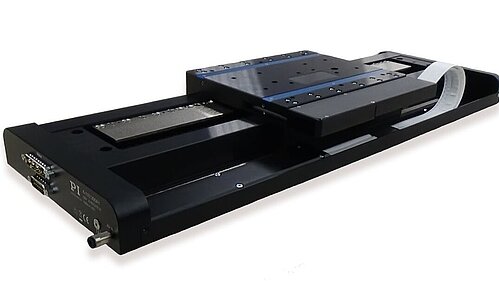
PI offers a broad portfolio of motorized linear stages. The huge variety of applications also means a huge variety of technical possibilities for the linear axes. Travel ranges extend from a few millimeters to meters and for precision classes, from nanometers to micrometers: PI adapts the drive, guides or sensor technology to the application conditions….
The Future of Photonics Won’t Be Built by Smarter Machines

It Will Be Built by Smarter Manufacturing.Read more [Picture source: Sander Slagter on linkedin.com]
The Fastest Machine Doesn’t Always Deliver the Highest Throughput

As photonics moves from innovation to industrial-scale manufacturing, the conversation is changing. For years, the focus has been on achieving higher precision, better alignment and faster motion. But once production starts to scale, another challenge quickly emerges: Throughput. Not because individual machines are too slow. But because manufacturing is only as fast as its slowest…
Automation Doesn’t Replace Precision. It Makes Precision Scalable.

For decades, the photonics industry has pushed the boundaries of precision. Nanometer positioning, sub-micron alignment and exceptional optical performance have enabled technologies that were once thought impossible. But achieving precision once is no longer enough. Read more [Picture source: Sander Slagter on linkedin.com]
The Next Competitive Advantage in Photonics Isn’t Precision. It’s Repeatability

Photonics has achieved remarkable levels of precision.Nanometer positioning. Sub-micron alignment. Extraordinary optical performance.But as the industry moves beyond R&D and into high-volume manufacturing, precision alone is no longer enough. Read more [Picture source: Sander Slagter on linkedin.com]