
If robots can work 24/7 without shedding skin particles, what’s still keeping humans inside cleanrooms?

People are a significant source of contamination in cleanrooms. Even with protective clothing, our movements can release particles into the air. Robots can help reduce this risk, but they are not completely contamination-free. Their moving parts can also generate particles, and they still need regular cleaning and maintenance. Read more [Picture source:…
What if you need to sneeze inside a cleanroom?

If you feel a sneeze coming, try to turn away from the product or sensitive work area and follow your cleanroom procedures. A sneeze releases droplets and microorganisms into the air, which can increase the risk of contamination. Read more [Picture source: ABN Cleanroom Technology on linkedin.com]
Are you allowed to talk inside a cleanroom?

Yes, but unnecessary conversation may need to be limited. Talking is not generally forbidden in a cleanroom. But there’s a reason unnecessary conversation may be kept to a minimum, especially during critical processes. Read more [Bron foto: ABN Cleanroom Technology NV op linkedin.com]
Can the speed you walk into a cleanroom affect contamination?

Yes. Walking speed can influence how many airborne particles are carried through an open doorway into a cleanroom. When someone enters a cleanroom, their movement disturbs the surrounding air and creates a wake behind the body. This wake can pull air and particles from the less clean side through the doorway.
ABN Cleanroom Technology starts construction of ViTalent cleanroom training facility
Over the past month, the cleanroom provider has begun construction of a training facility in Belgium and has also delivered a satellite manufacturing facility in Spain for Kreios Space Read more [Source: cleanroomtechnology.com]
ISO6 cleanroom for Wilting
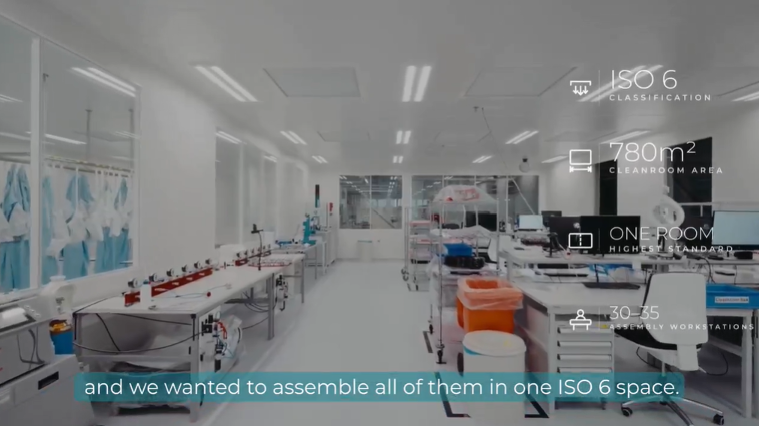
Precision is non-negotiable in the semiconductor industry. That’s why Wilting, a manufacturer of high precision mechanics and modules for sectors like semiconductor and aerospace, chose ABN Cleanroom Technology NV to build their ISO 6 cleanroom. Read more and…
WHITEPAPER – Design Driven by Sources
Cleanroom design has relied on the same fixed table for decades: a set number of air changes per hour for ISO 8, more for ISO 7, more still for ISO 6. These numbers feel familiar and safe, but they describe an outcome, not a cause. A cleanroom is clean because the supply of clean air outpaces the contamination generated…
What can AI actually do inside a cleanroom?

AI can predict problems before they happen, instead of reacting once something’s already wrong. Read more [Picture source: ABN Cleanroom Technology NV on linkedin.com]
ATLAS Prime: A new standard for controlled environment development
Designing a facility has always involved many moving parts. Consultants, HVAC engineers, process specialists, cost estimators, and validation experts each work in sequence, each adding time to the overall process. The result is a process that takes weeks before an end user receives a first layout, an indicative CAPEX budget, or any insight into future operating costs. For industries…
ABN Cleanroom Technology: innovatie als fundament voor marktleiderschap in cleanrooms
Van medicijnen en microchips tot satellieten en ruimtevaarttechnologie: steeds meer innovatieve producten worden ontwikkeld in een gecontroleerde omgeving waar zelfs de kleinste stofdeeltjes of micro-organismen een proces kunnen verstoren. ABN Cleanroom Technology uit Bilzen specialiseert zich al dertig jaar in het ontwerpen, bouwen en onderhouden van dergelijke cleanrooms. Dankzij verschillende VLAIO-ontwikkelingsprojecten groeide het bedrijf uit tot een innovatieve pionier…